Speed Specs
Vehicle: TEN-T Truggy
Manufacturer: Losi
Part Number: LOSB0126
Vehicle Class/Type: 1/10-scale Nitro Truggy
Target Audience: Backyard Basher to Intermediate/Casual Racer
Kit/RTR/BND/Race Roller: RTR
Test Items Used
Nitrotane 20%, Quart (LOSF0120)
Losi 500cc Fuel Bottle (LOSB5201)
320 Series Kingpin Tire with Inserts, Red (LOSA7689R)
320S Force Wheel, Chrome (LOSB7013)
Track Notes
With a new vehicle, and really a new vehicle type, I decided what more perfect place to test it than on a new track. Dewey’s RC in Springfield, Illinois has only been open a few months but has seen a nice turnout on both practice and race days. The track at Dewey’s is tight and technical, however, you can get some real speed going coming onto the main straight, around the sweeper and into the first corner. Grip is normally pretty good here as the track holds quite a bit of moisture in the dirt itself. This is also one of the only RC tracks in the area that allows nitro vehicles to be run indoors, a necessity with the TEN-T for obvious reasons.
Before heading to the track, I spent a few minutes with the TEN-T on the bench. The truck seemed very well put together and the R.O.S.S. was quite interesting to me. I put some Nitrotane 20% in the fuel tank, turned the truck on and hit the starter button on the DX3S. I heard a very high-pitched beep for about a second before the starter motor began cranking the engine over. I snuffed the stinger to help prime the system until I noticed all the air bubbles had worked their way out of the fuel line and into the carb. I was shocked at how quickly this happened, so please take note—this fuel system pressurizes itself very quickly and easily. If the truck doesn’t start within a few seconds, check to make sure you haven’t flooded the engine (as it should fire up rather easily after a few seconds). Also, after the engine initially fires up, keep your finger on the starter button for a little bit as you drive the truck around. This will help keep the glow plug lit while the one-way bearing prevents any unnecessary drag on the engine or starter mechanism.
Top Speed/Acceleration
I had high hopes for the engine in the TEN-T, especially since it’s the same powerplant that resides in the engine bay of the Speed-NT. The 3.4cc engine might seem a bit small if you’re used to the .28’s and such that are found in larger 1/8-scale vehicles, but I am here to tell you it’s the perfect engine for this truck. Once the needles had been tuned and the engine was up to the proper operating temperature, I was very impressed with how fast this “little” truck is. I’d estimate top speed was near 40 mph, and that was with a relatively conservative needle and fuel combo. I am sure I could get it over 40 mph with some 30% Race Blend Nitrotane and leaning out the needles a little more.
The TEN-T doesn’t just show what it’s got on the high end though as it has a ton of power on the bottom to get it up and over many obstacles. Add full-time four-wheel-drive in the mix and you not only have stump-pulling torque but the traction to hook it up. The TEN-T accelerated hard each and every time I grabbed a handful of throttle, propelling it forward with authority.
Jumping
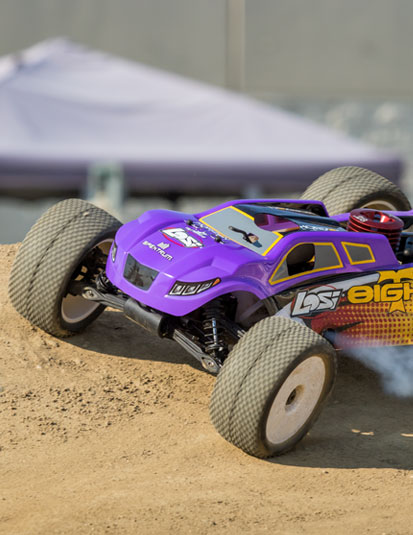
One thing the 8IGHT and 8IGHT-T are well known for is how well they jump and how controllable they are once their tires get off the ground. It was no surprise to me that the TEN-T had the exact same characteristics once the tires left the track and the truck was airborne. If the truck took a nose-up attitude, a simple jab of the brakes would bring the nose down nicely. If the nose was pointed down in the air, burping the throttle would bring the nose up predictably.
Out of the box I did feel that the front end didn’t have quite enough preload on the front springs, however, which made the truck nose-in on some of the jumps that had a faster approach. I was able to add some preload easily enough by turning the adjustment collars down a few turns on each of the front shocks which helped the approach quite a bit. In all I think I turned each collar down about 3 turns per side, which seemed good to me.
Handling
Ok, this is one of those times when I am going to have to give you a ‘before’ and ‘after,’ as I did make a tire change part of the way through the day which altered the handling. The truck was neutral with a touch of understeer on-power, something not totally unexpected with a 4WD truck. With the kit preload, the front end had a lot of movement to it when I would get on and off the throttle, but the preload adjustment I mentioned above eliminated some of that as the static ride height was increased. On the dirt, I was actually really impressed at the bite provided by the kit tires. They have a very unconventional pin and tread pattern that I didn’t expect much out of, but they were actually passable. I had something stashed in my pit box that would help change the handling of the truck in a few minutes.
Now while the kit tires weren’t the perfect ticket on the racetrack, I had a set of 320-Series Red Compound KingPin tires tucked up my sleeve that I was eager to bolt on and try out. From the word ‘go’ I could feel a difference with these new shoes on the four corners of the TEN-T. From initial acceleration to corner speed, the truck had much more overall grip. The right-handed turn before the triples was much less challenging now as I had more forward bite to get up and over that section. The KingPin tires provided me with a lot more confidence in the TEN-T—I could hustle it a lot more around the track at Dewey’s and it would stay in the groove. I could now charge corners harder, nail the brakes, get the truck sideways a bit and then hammer the throttle to pull the truck through the corner. I’m here to tell you if you have any desire to race this truck and you’re going to be running on a hard-packed surface, you need a set of these ASAP.
A side benefit of the KingPin tires was a reduced rollout, referring to the total gear ratio in a vehicle, including the diameter of the tires. The KingPin tire has an overall diameter that is slightly smaller, mostly due to the smaller pins. Combine this factor with a tire that has less overall rubber and you get a truck that accelerates a little better. I’d say the best way to describe this would be to say it was as if I had dropped a tooth on the clutch bell—nothing huge, but noticeable none-the-less.
Off-Power
As I mentioned earlier the TEN-T needed some additional preload from the box to help it better approach and clear jumps. Along with helping the jumping, this increased front preload also gave the front end more overall travel to help the truck corner better. Out-of-the-box the front end did not have enough travel, and the performance suffered because of this. In addition the down travel allowed by the shocks and A-arms could cause the truck to diff out if I charged a corner too hard. It’s nice to know that such a simple and easy adjustment can have such a positive impact on the handling.
With the kit Zombie Max tires the TEN-T felt decent off-power into high-speed corners. Where it suffered a bit was with low-speed steering as I could have used some more front bite in that scenario. I can totally chalk this up to the track surface and the Zombie Max tires not being an ideal match, however, things were much improved with the KingPin tires. If anything I felt that the KingPins had a bit too much steering to them, but nothing so edgy that a simple change of how I was entering a corner didn’t fix the problem. While in the end I did find more bite with the KingPin tires, I will say once again that running this truck on a racetrack is probably where the fewest number of TEN-T’s will be run. For outdoor running on grass, asphalt or other surface the TEN-T’s stock tires work just fine.
On-Power
Hold on when you grab a handful of throttle with the TEN-T because it gets up and goes in a hurry. I didn’t mess around with the rear shock preload like I did with the front. The truck just didn’t seem to need help back there. On-power, the TEN-T would just squat and go, exactly like its larger cousins the 8IGHT 2.0 and the 8IGHT-T 2.0. The forward traction was excellent, and I think a lot of that credit has to go to the overall chassis layout and weight placement. For an RTR, I have always said it is better to have a vehicle with too much bite than not enough, and the TEN-T nails it with really good on-power steering without sacrificing rear traction.
Out-Of-The-Box Setup
The TEN-T works straight from the box with one or two minor changes. The truck has a slight tendency to push on-power with a neutral feeling off—a very good combination for the audience this truck is aiming for. Out of the box the truck felt good on a variety of surfaces. From grass, asphalt and eventually the track at Dewey’s the TEN-T never exhibited any bad handling characteristics. The kit tires did have a bit of a numb feeling to them, especially at low-speeds where I felt like I had to wait for the truck to rotate or for the front end to get enough bite to pull the truck through the corner. That’s not a bad thing as you have to keep in mind that most TEN-T’s will never see the likes of a racetrack. The one spot where I really felt like it was hurting my lap times was the right-hand turn before the triple section. I had to wait for the truck to turn, or simply take a wider apex, to get the truck around that corner.
There are a few things that I was able to do in short order to help improve the feel and driving nature of the TEN-T. I’ve already talked about increasing the front ride height but another thing that I did was to take some time with the truck, once the ride height was set properly, to set the front and rear camber. From the box the front end had about ½ degree of negative camber while the rear end had 1 degree of positive camber. Now, unless you’re running oval, there’s never a situation where you’d want to run positive camber on your car or truck. Setting the camber was easy and, using my Losi Camber Gauge, I set the front end for 1 degree of negative camber up front and 2 degrees of negative camber in the rear. This really made the TEN-T feel more consistent to me, mainly because I wasn’t fighting the sidewall of the tire when the truck was cornering. The entire face of the tire could work for me now, improving my grip and reducing wear on the tire.
The TEN-T from Losi is really a dichotomy. It represents 1/8-scale technology in a smaller 1/10-scale package. Other manufacturers have tried to make the “mini-truggy” class work before now but none have offered a package anything like the TEN-T. Let me be clear about this as no-other 1/10 or 1/12-scale nitro truggy comes in as complete of a package with as many innovative and easy-to-use features as the TEN-T. The R.O.S.S. isn’t a gimmick as it really works and is so much nicer than dealing with a hand starter or other method of starting a nitro engine. From a handling and suspension standpoint, it again borrows from proven 1/8-scale technology and delivers again. Wrap all this up with a DX3S transmitter and you can see what I am saying regarding the value this truck delivers. Above all else, the thing to remember about the TEN-T is that it provides a fun experience. I wish the truck came with a larger fuel tank just so that I could have more fun without thinking about running out of fuel. But even if I do run out, it’s no big deal. All I have to do is add some more Nitrotane and at the push of one little button the fun starts all over again.